
A report by the Carnegie Endowment for International Peace has reinforced the Obama administration's campaign to lobby the Indian government to award the $11 billion contract for 126 medium multi-role combat aircraft to US manufacturers.

Outsourcing of jobs to India was one of the major election issues in the November 2 American mid-term elections.
The United States should fully back India's pursuit of permanent membership of the powerful UN Security Council, John McCain, the top Republican leader said, days after President Barack Obama described the issue as "very difficult and complicated".
'A lot of people in India are not ready to move on. You are still concerned that any defence deal with the US will constrain your strategic autonomy, as if the US had the power to do that,' says Michael Krepon, co-founder of the Henry L Stimson Centre, a Washington, DC think-tank.
Noting that the United States can only contribute marginally to India's success or failure, a report prepared by the Washington-based think- tank Carnegie Endowment for International Peace says it is in fact the actions of Indians at home and abroad that will determine which path India takes.

The author of a definitive guide to the Kashmir crisis speaks with Managing Editor Aziz Haniffa.
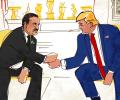
'Trump has personally weighed in to overcome doubts and reservations about Pakistan among his top advisors.'
In his book Lashkar-e-Taiba, From 9/11 to Mumbai, author Stephen Tankel points out that the 60-hour terror siege on Mumbai had catapulted the LeT to international notoriety.
Tyagi has said that in the changing phase of international relations, economic security also becomes vital.
Tariq Fatemi, a former Pakistani ambassador to the United States, said President Pervez Musharraf's failure to rout terrorism in Pakistan was largely because he did not have popular support, as the war on terror was seen by the people as 'America's war.'
Retired Commodore Uday Bhaskar, leading strategic analyst, has predicted that the Indo-US relationship 10 years into the future will still remain on track even if the bilateral civilian nuclear deal is not consummated because it is now driven largely by non-government actors.

South Asia experts have called the recent Obama-Singh meet a success, going by the positive signals given by both sides in all major areas of cooperation, both bilateral and multilateral.
Leading South Asia experts have assured the United States Congress that the prospect of Pakistan's nuclear arsenal falling into fundamentalist hands is, at least in the short term, unlikely.
'Lashkar clearly poses the greatest danger to India,' says Stephen Tankel, author of a book on the Lashkar-e-Tayiba.

Terming United States President Barack Obama's maiden trip to India as a triumph, noted American experts cutting across ideological spectrum on Monday said that it has taken the Indo-US relationship to an altogether new level.
Tariq Fatemi, former Pakistani ambassador to the United States and principal foreign policy adviser to erstwhile prime minister Nawaz Sharif, has urged New Delhi to lift the 'pause button' on the Indo-Pakistan composite dialogue, which was imposed after the Mumbai terror attacks.
Accusing the Pakistan army of inflating the threat of religious sectarianism and jihadi extremism for its own self-interest, the report said the West adopted a more lenient attitude toward the regime due to a perceived lack of alternative.
David C Mulford, who will soon vacate his post as United States'ambassador to India, has urged the Obama administration to ensure the implementation of the India-US civilian nuclear agreement.In an interaction at the Carnegie Endowment for International Peace in Washington, Mulford said, "The nuclear deal may be completed, but the work isn't done. There is unfinished business there to be done."
Strategic affairs specialist Ashley Tellis believes the November 26 terror attacks on Mumbai has given birth to the "misguided notion" that a resolution of the Kashmir dispute is imperative to rein in terrorism in South Asia, and that this should be the priority of the proposed special envoy to the region.
At a seminar in Washington, DC, the consensus among a high-profile group of former diplomats, military leaders, politicians, businessmen and others was that the Mumbai terror attacks was a tangible manifestation of a global threat that calls for a global response.
The prize, comprising Rs one lakh, a plaque and an invitation to lecture in Delhi, will be awarded at a function to be held in April.
India is not only the world's largest democracy, it is also a powerful model for other emerging democracies, a top United States official said on Wednesday.India is a model of tolerance and of strength in diversity, Under Secretary of State for Political Affairs William J Burns said. He pointed out that the bilateral ties between the two countries had 'come a long way'.

When a media person asked why despite the affinity the United States had such a hard time endorsing India's bid for a permanent seat in the United Nations Security Council, Burns went into a spin.
Ahead of the crucial Itentaional Atomic Energy Agency meeting on Friday, a group of arms control experts has urged both the atomic watchdog and Nuclear Suppliers Group to look at the Indo-US nuclear deal 'very carefully and remove all ambiguities'.
Burns said, "What is paramount to any agreement is a country's obligations to its own laws, and so we have preserved -- as we must -- our obligations under US laws in this agreement."
It was said that there is a gap in the foreign policy aspirations of Moscow and Washington.
Ashley Tellis denies saying that the US 'got more from the government of Dr Manmohan Singh.' rediff stands by the interview.

Dr Singh's tough talk has put the onus on the US Senate.

'...it should not delude itself into thinking that India's security or its great-power ambitions will be advanced by those partnerships.'
'Instead, what India should focus on is on riding out the next three-and-a-half years of Trump's presidency with minimal damage to itself.'
